Any tips on MA13 staging estuary coho? There's lots of them!

7Derp

Freshly Spawned
The last couple of years have seen massive numbers of hatchery coho showing up all over MA13 and its estuaries.

I've had success with spinners and rotator lures, but only on lucky days (and boy do they bite like crazy on those days!). I figured going to a small fly would be more effective on days when they are lockjaw. It's hard to get distance on casts using geared setup with tiny 1/16 ounce lures.

Or, am I just wasting my time here? Would going to microscopic flies work to entice lockjaw estuary coho?

Thanks for any help anyone can provide, especially with MA13 estuary coho experience.
 
Last edited:
The last couple of years have seen massive numbers of hatchery coho showing up all over MA13.

I get about 1,000+ of them stacked up in front of my next door neighbor's house waiting for multiple streams to get water, so they can spawn.

They're not worth eating once they have been around for more than a day, in my opinion, but I would still like to hook into them, and rarely in the late part of the run in colder water some of the fat hooknose bucks can eat pretty good.

I've had success with spinners and rotator lures, but only on lucky days (and boy do they bite like crazy on those days!). I figured going to a small fly would be more effective on days when they are lockjaw or easy to spook. It's hard to get distance on casts using geared setup with tiny 1/16 ounce lures.

So far, I've been setting up my 14' 9wt Spey/Skagit rod with a 650 grain head and mono shooting line. I also tied up several bunny sucking leeches in #2 and a few of the microscopic #12 pink and chartreuse mini-buggy-jiggy things people posted in the freshwater coho thread.

Or, am I just wasting my time here? Would going to microscopic flies work to entice lockjaw estuary coho?

Thanks for any help anyone can provide, especially with MA13 estuary coho experience.
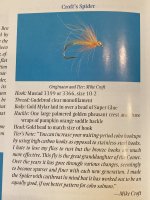
I have fished Croft’s Spider in a size 10 on a slow retreive on an intermediate line for “waiting period” coho with good success.
Leland
 

Attachments

  • 85AFABC0-7684-4FF7-8F49-AE088B28704F.jpeg
    85AFABC0-7684-4FF7-8F49-AE088B28704F.jpeg
    780.7 KB · Views: 48
@7Derp I was out on a MA13 beach yesterday and saw a nice school of silvers go by while standing on some rocks. So I cast and spooked them, then repeated the situation one more time.

That’s when I decided I am downsizing rods to a 7wt or 6wt single handle. The line is spooking them not the fly, these fish are on the top part of the water column cruising edges they can see line. And that 650gr doesn’t exactly land like a butterfly either.

Spoke with Bjorn in frustration after and he agreed. Also said try small light pink or chartreuse clousers/minnow.

I’m going to try again today or tomorrow.
 
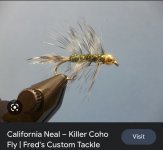
California Neil would be another pattern to consider.
I’d like to hear more on your thoughts as to why they wouldn’t taste good.
Thanks
SF
 
So far, I've been setting up my 14' 9wt Spey/Skagit rod with a 650 grain head and mono shooting line.

That rig is going to spook every coho within half a mile. If it’s not the line splash, the big rod waving in the air will do it. Downsize to something like a 6 weight, or even lighter if it’s calm and you think you can fish that small for big fish. Lengthen your leader. 16 - 20’ or more. Don’t cast over fish. Make fewer casts, and make them count. And when the first buzz bomber shows up, walk away.
 
I'd feel confident saying that the smell of you wading in the water isn't putting them off the bite. It's more the fact that staging coho just aren't "on the bite" much. I've spent way too much time casting to staging fish, to the point that I'm really not super interested in doing so at this point. IME they will get bitey at some point during most days, often for some small random window of time that can't be predicted. Small patterns can definitely produce well during these times, but so can larger stuff as you've clearly experienced with your gear offerings. First light and last light can sometimes produce, and sometimes not.

Sounds like you have the advantage of being able to fish over these fish at most times of your choosing, so you're bound to hit some of their bitey times if you fish enough. I just believe that this isn't a puzzle that can be fully cracked by a fly pattern. Staging fish are just assholes most of the time.

I do agree though that that big heavy rod/line isn't likely doing you any favors.

Just my two cents
 
So, I was reading maybe here or elsewhere that the spawning coho, especially to smaller streams, are triggered by smaller flies resembling what they were eating when they were wee-lads in the streams several years prior.

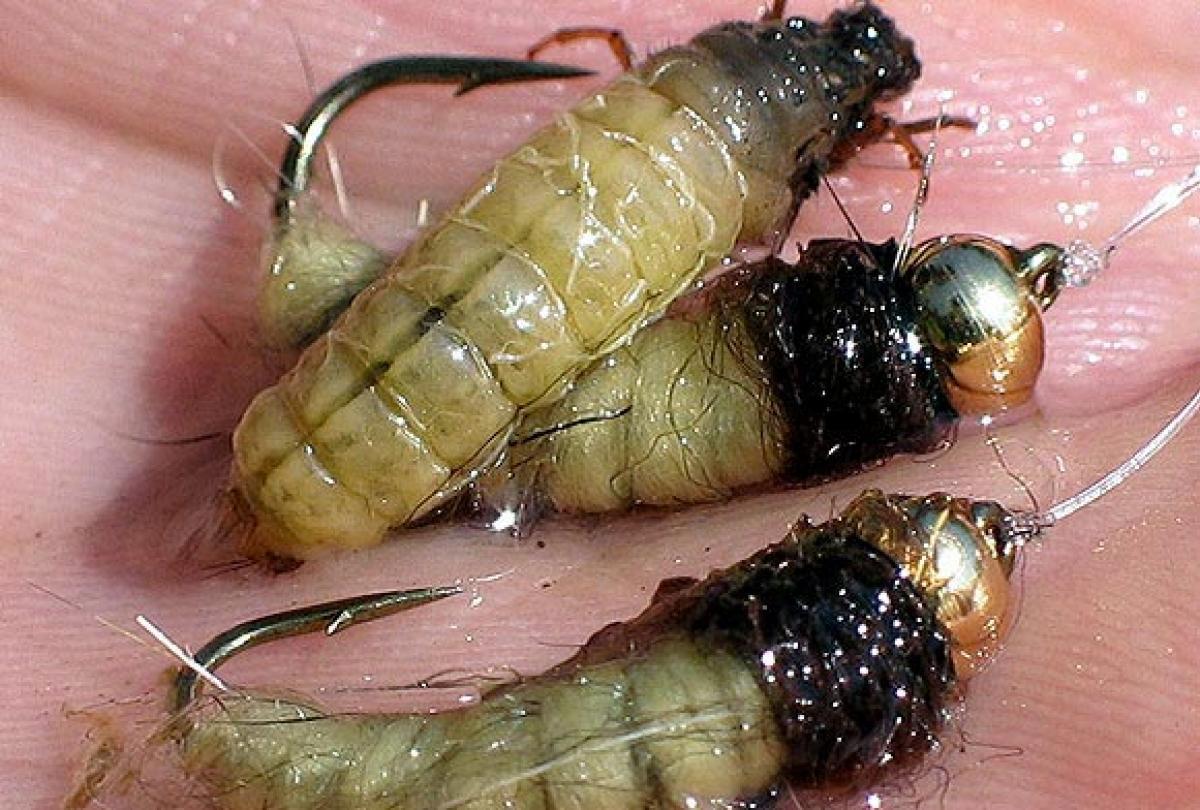
In these streams, which I fished a lot when they were open to regular fishing back in the day, Caddisfly Larvae were by far without any question the most choice food on their menu. I could catch fish all day long with just a single caddisfly larvae head on a size 6 hook. That went for pretty much any salmonid in the "trout" size range.

I might even be tempted to grab some caddisfly larvae next spring and put them in the freezer and see if these staging coho wouldn't be willing to take one down the gullet.

I don't know how many of you have fished with a caddisfly larvae with the shell removed, but they are like crack-cocaine for salmonids. I've never seen anything quite as effective in our region, bait-wise. They fish really well on the drop. They spread their legs out when they tumble down the stream, after losing their footing and look like floating spiders wiggling along. Creepy little bastards. LOL

I'll dink around with maybe trying to tie something up for a caddisfly larvae.

This is really close to what they look like, although I would use a black bead and put some pronounced legs on it, and some nuclear-blue guts out the back.

https://globalflyfisher.com/patterns/sharks-caddis-larva

caddis.jpg
 
Last edited:
They develop a certain enzyme or something that the vast, vast majority of people who eat salmon can't taste. If you live at the mouth of a busy salmon stream, you get a taste for this chemical and can never untaste it. It's not even that the chemical or chemicals taste bad, they just cause this gag and vomit reflex.

I think another major factor is smelling rotten salmon carcasses for months. That chemical we can sense might be in high abundance in rotting salmon and incorporates that into the smell reaction. My body thinks it is eating rotten food if there is even the smallest hint of that chemical in the meat.

Thus profuse vomiting. 🤮
Actually, I can make it happen pretty much 100% of the time walking into the water. It's not so much putting them off the bite literally as much as they move out of the area and casting range if my scent is in the water for too long. I don't wear waders, and it actually makes a large difference. There can be 3+ guys in waders with fish rolling stacked close by, but if I wade in, even like a ninja, the fish will eventually take off. I think I produce a very large amount of L-Serine compared to other people. In larger rivers, I can control the flow and direction of all the spawning salmon with my scent, even with tons of other fishermen in the water who are in waders. They basically smell me as the biggest grizzly bear in the world and keep their distance. LOL
This guy has to be trolling us.
 
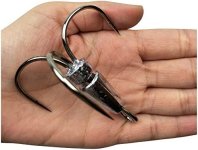
I have had some success with a small Hotshot that rattles, a red and white color scheme. Hold on the strikes are vicious and be sure to change out the factory hook with a Gamagatsu siwash.

This is a hit and miss thing but if they are somewhat inclined this seems to irritate the hell out of them. I have had eyes opened up, hooks straightened and hooks pulled off the lure. Don't have your drag set very tight let them hit and run . The freight train will slow down and then add some drag slowly. For some reason an average coho of say 9 or 10 pounds acts and feels like a teener fish.

I think that probably any small rattling Hot shot would work and they are kind of fun to pull.

Dave
 
They slime up super fast in warmer water. Even just a day or two, and they're not edible by myself or anyone in my neighborhood. Even after extreme smoking and taking the skin off, etc. The chum hold up the best compared to the coho and chinook that come in, seriously LOL.

They develop a certain enzyme or something that the vast, vast majority of people who eat salmon can't taste. If you live at the mouth of a busy salmon stream, you get a taste for this chemical and can never untaste it. It's not even that the chemical or chemicals taste bad, they just cause this gag and vomit reflex.

I think another major factor is smelling rotten salmon carcasses for months. That chemical we can sense might be in high abundance in rotting salmon and incorporates that into the smell reaction. My body thinks it is eating rotten food if there is even the smallest hint of that chemical in the meat.

Thus profuse vomiting. 🤮
First world problem.
 
Personally I think you are way over thinking this.
I won't argue on the table quality of those fish as I am not eating them, but I will never be convinced that the smell of human is putting staging coho "off the bite". Still, seems like a pretty simple solution to that problem if you truly believe that to be the case......wear waders?

Staging fish are assholes. Staging fish are not traveling, feeding fish. They are preparing to spawn. Feeding heavily is just not part of the equation. Can they be caught? Sure, at times. But far more often than not they will laugh at anything you throw at them, whether or not they smell your Dove fresh skin.

And for the record I definitely grew up using "periwinkles" as bait. Lots of great memories there. I'm doubtful any sort of biological memory from their stream time is going to be the magic trick to get non feeding fish to get aggressive, but can't hurt to try.
 
Back
Top