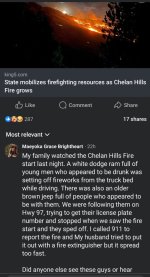
NFR New wildfires popping up on a daily basis!

Non-fishing related
Here's something even easier to find: Just plug in "relationship of low snow pack to wildfires" and see what you come up with. I don't need media coverage to tell me that the town I live in has been on all levels of evacuation. A couple of years ago I watched the entire hillsides right outside of my town burn right down to local orchards. Maybe you should send your findings to the people in Winthrop right now who have been evacuated. Sorry, but those of us who have lived this don't take your "some years" and your personal dislike for the media very serious.

Increased Fire Severity: Research published by "Western Colorado Univ" indicates that low snow water content (the actual amount of water stored in the snow) directly correlates with burn severity. Dry forests experience higher tree mortality, deeper burns, and a higher liklihood of permanent forest loss. This is not media hype, it's common sense.


Well actually your reply kinda validated my point about headlines often being misleading. The title doesn’t make any false claims however without examining closer it can easily be misleading.

Look closer at the data and the definitions they used for the variables in the study you just referred to.

The study you mentioned looked at the variables of snowpack, early melt off, severity of fires, and total number of acres burned. Interestingly they did not cite a correlation between low snowpack and number of acres burned but rather they found a correlation between low snow pack and burn severity (ie temperature and heat of the actual fire) This is NOT the same as total number of acres burned. I am sure that if they had found a strong correlation between low snowpack and total number of acres burned then they would have said so.

There are other factors that have a much greater influence on number of acres burned than snowpack. There have been years with great snowpack and high number of acres burned and other years with low snow pack and low number of acres burned. Hopefully this year we will be the latter. Only time will tell.
 
Well actually your reply kinda validated my point about headlines often being misleading. The title doesn’t make any false claims however without examining closer it can easily be misleading.

Look closer at the data and the definitions they used for the variables in the study you just referred to.

The study you mentioned looked at the variables of snowpack, early melt off, severity of fires, and total number of acres burned. Interestingly they did not cite a correlation between low snowpack and number of acres burned but rather they found a correlation between low snow pack and burn severity (ie temperature and heat of the actual fire) This is NOT the same as total number of acres burned. I am sure that if they had found a strong correlation between low snowpack and total number of acres burned then they would have said so.

There are other factors that have a much greater influence on number of acres burned than snowpack. There have been years with great snowpack and high number of acres burned and other years with low snow pack and low number of acres burned. Hopefully this year we will be the latter. Only time will tell.
Most of us who have lived through this can give you anecdotal evidence that fires are burning larger and larger swaths of land. And, your comment pointing out that the article I supplied did not specifically include area burned is your conclusion and gives no credence to your theory. https://www.fs.usda.gov/rm/pubs_journals/2025/rmrs_2025_parks_s003.pdf

Here is the abstract that clearly (and specifically) points out that area burned has also vastly increased: Oh, and by the way there were several more articles that indicated a large increase in area burned.

Area burned by wildfire has increased in western US forests and elsewhere over recent decades coincident with warmer and
drier fire seasons.
However, high–severity fire—fire that kills all or most trees—is arguably a more important metric of fire ac-
tivity given its destabilizing influence on forest ecosystems and direct and indirect impacts to human communities. Here, we
quantified area burned and area burned severely in western US forests from 1985 to 2022 and evaluated trends through time.
We also assessed key relationships between area burned, extent and proportion burned severely, and fire season climate aridity.
Lastly, using the strong relationships between fire season aridity and both area burned and area burned severely, we predicted
future fire activity under ongoing warming. While annual area burned increased 10-fold over our study period, area burned se-
verely increased 15-fold. Disproportionate increases in severe fire occurred across a wide range of forest types from 1985 to 2022.
Importantly, we found that the proportion of area burned severely increased with fire extent at the scale of individual fires and
total annual area burned. The relationships between fire season aridity and fire were strong, and our models predicted further increases in fire activity, leading to 2.9- and 4-fold increases in area burned and area burned severely, respectively, under mid-21st century climate.
Without a substantial expansion of management activities that effectively reduce fire severity (e.g., thinning of understory and fire-intolerant trees combined with prescribed fire), wildfires will increasingly drive forest loss and degrade eco-
system services including carbon storage, biodiversity conservation, and water yield, with major impacts to human communities.

Here are two more blips for you to consider:

Actually the area burned and the severity are both increasing at an alarming rate: https://www.fs.usda.gov/rm/pubs_journals/2025/rmrs_2025_parks_s003.pdf

Results: "Pretty conclusive evidence that severity means area burned as well"!

Annual area burned and area burned severely have increased
markedly from 1985 to 2022 in western US forests (Figure 2;
p < 0.001). In fact, annual area burned exhibited a 10-fold in-
crease and area burned severely a 15-fold increase from 1985
to 2022. Strikingly, over 16,000 km2 of forest in the western US
burned in each of 2020 and 2021; of which, 46% and 36% burned
severely, respectively (Figure 2). We also quantified these trends
for each ‘fire regime group’ (FRGs) (Figure S1a) to gain a better
understanding how these trends may vary among broad forest
types. In doing do, similar increases in area burned and area
burned severely were observed across each FRG over the study
period, with disproportionate increases in area burned severely
(Figure S2).
We found that annual proportion burned severely across west-
ern US forests increased with annual area burned (Figure 2b).
This relationship is mirrored at the scale of individual fires: as
fire size increases, so too does the proportion burned severely
(Figure 3a). Annual median fire size also increased through time
(Figure 3b) and with fire season aridity (Figure S3). Collectively,
these relationships indicate that not only are warmer, drier
conditions linked to increasing fire size, but additionally,
these larger fires are associated with a larger proportion burn-
ing severely


I guess what bothers me the most is that someone would debate such a meaningless piece of date in lieu of the horror that that wildfires bring to communities. If you were to interview someone who has had to somehow recover from this nightmare I seriously doubt they would care to quantify how much actual area has been increasing or decreasing. Point being that there is tons of evidence that Wildfire season is increasing, severity is increasing, area burned is increasing, and severity of area burned is increasing dramatically and that Climate Change is a major culprit.
 
Last edited:
I am glad your article pointed out that "burned areas are increasing". Fuel Accumulation VS Climate Change to me is not a debate. As I pointed out Climate Change is a major factor. Instead, consider the following:
Fuel accumulation increases the intensity and spread of wildfires while Climate change contributes to longer fire seasons and drier conditions. Both factors are interconnected; climate change exacerbates fuel accumulation. Effective forest management can mitigate fuel buildup and reduce fire risks.

I do believe that Climate change impacts are broader, affecting ecosystems and weather patterns and addressing both issues is crucial for comprehensive wildfire prevention strategies. To say that the "epidemic of trees" is the sole problem sounds more like a political stubbornness aimed at Climate Change.
 
Last edited:
Most of us who have lived through this can give you anecdotal evidence that fires are burning larger and larger swaths of land. And, your comment pointing out that the article I supplied did not specifically include area burned is your conclusion and gives no credence to your theory. https://www.fs.usda.gov/rm/pubs_journals/2025/rmrs_2025_parks_s003.pdf

Here is the abstract that clearly (and specifically) points out that area burned has also vastly increased: Oh, and by the way there were several more articles that indicated a large increase in area burned.

Area burned by wildfire has increased in western US forests and elsewhere over recent decades coincident with warmer and
drier fire seasons.
However, high–severity fire—fire that kills all or most trees—is arguably a more important metric of fire ac-
tivity given its destabilizing influence on forest ecosystems and direct and indirect impacts to human communities. Here, we
quantified area burned and area burned severely in western US forests from 1985 to 2022 and evaluated trends through time.
We also assessed key relationships between area burned, extent and proportion burned severely, and fire season climate aridity.
Lastly, using the strong relationships between fire season aridity and both area burned and area burned severely, we predicted
future fire activity under ongoing warming. While annual area burned increased 10-fold over our study period, area burned se-
verely increased 15-fold. Disproportionate increases in severe fire occurred across a wide range of forest types from 1985 to 2022.
Importantly, we found that the proportion of area burned severely increased with fire extent at the scale of individual fires and
total annual area burned. The relationships between fire season aridity and fire were strong, and our models predicted further increases in fire activity, leading to 2.9- and 4-fold increases in area burned and area burned severely, respectively, under mid-21st century climate.
Without a substantial expansion of management activities that effectively reduce fire severity (e.g., thinning of understory and fire-intolerant trees combined with prescribed fire), wildfires will increasingly drive forest loss and degrade eco-
system services including carbon storage, biodiversity conservation, and water yield, with major impacts to human communities.

Here are two more blips for you to consider:

Actually the area burned and the severity are both increasing at an alarming rate: https://www.fs.usda.gov/rm/pubs_journals/2025/rmrs_2025_parks_s003.pdf

Results: "Pretty conclusive evidence that severity means area burned as well"!

Annual area burned and area burned severely have increased
markedly from 1985 to 2022 in western US forests (Figure 2;
p < 0.001). In fact, annual area burned exhibited a 10-fold in-
crease and area burned severely a 15-fold increase from 1985
to 2022. Strikingly, over 16,000 km2 of forest in the western US
burned in each of 2020 and 2021; of which, 46% and 36% burned
severely, respectively (Figure 2). We also quantified these trends
for each ‘fire regime group’ (FRGs) (Figure S1a) to gain a better
understanding how these trends may vary among broad forest
types. In doing do, similar increases in area burned and area
burned severely were observed across each FRG over the study
period, with disproportionate increases in area burned severely
(Figure S2).
We found that annual proportion burned severely across west-
ern US forests increased with annual area burned (Figure 2b).
This relationship is mirrored at the scale of individual fires: as
fire size increases, so too does the proportion burned severely
(Figure 3a). Annual median fire size also increased through time
(Figure 3b) and with fire season aridity (Figure S3). Collectively,
these relationships indicate that not only are warmer, drier
conditions linked to increasing fire size, but additionally,
these larger fires are associated with a larger proportion burn-
ing severely


I guess what bothers me the most is that someone would debate such a meaningless piece of date in lieu of the horror that that wildfires bring to communities. If you were to interview someone who has had to somehow recover from this nightmare I seriously doubt they would care to quantify how much actual area has been increasing or decreasing. Point being that there is tons of evidence that Wildfire season is increasing, severity is increasing, area burned is increasing, and severity of area burned is increasing dramatically and that Climate Change is a major culprit.
But that i have just one like to give!!
 
I find it sad that rather than asking clarifying questions and or presenting facts like @Flymph to counter something believed to be incorrect, memes are frequently used to marginalize and ridicule an opposing view. Cancel Culture is still strong.

What can we actually do to impact the frequency and severity of wildfires? Here are the two of the most discussed options.

Slow, stop, or even reverse Climate Change?
Washington State has spent $1.5B of $4.74B collected as of late 2025 on projects such as community investments (over $850M) and environmental initiatives that as of the last report that WADOE has (had the courage to admit) removed 78,000 metric tons of 96.1 million metric tons of annual greenhouse gas emissions.

The "green" solution sounds GREAT but is it actually doing anything for the money being spent? In Washington State that is a big NO. However the UN-backed Intergovernmental Panel on Climate Change (IPCC) that officially retired its most extreme future emissions scenario (RCP8.5) after researchers determined these projections of 4-5°C warming by 2100 are now implausible, moved their worst-case doomsday predictions off the table. But they claimed that their initiatives are the reason!

Forest Management to include selectively removing smaller, overcrowded, or diseased trees to reduce competition and limit the continuous canopy and brush removal & Pruning
I can't really find anything that lists how much has been spent by Washington State and the Federal government on forest management in Washington state to prevent wildfires since 2024? It sounds like perhaps $90M to possibly $170M has been spent on Forest Management AND Fire Suppression.

And while I cannot find hard data for Washington State or how effective Forest Management alone is for reducing wildfires, the USFS says wildfire management and suppression save millions of acres and thousands of structures annually. "Federal, state, and local agencies successfully suppress up to 98% of wildfires before they grow, while prescribed burning, thinning, and fuel management treat millions of acres yearly to prevent megafires". I also found that Washington State produces 4 to 10 million metric tons of \(CO_{2}\) equivalent per severe fire season.

🤔 4M to 10M metric tons for (a possible high of) $170M and saving mucho acreage vs. 78K metric tons for $1.5B and still spending the $170M???

Question: Would taking at least some of that unspent $3.24B of CCA money and spending it on Forest Management and Fire Suppression be a better use of the money and deliver more results?
 
Question: Would taking at least some of that unspent $3.24B of CCA money and spending it on Forest Management and Fire Suppression be a better use of the money and deliver more results?
I think that is impossible to know due to so many factors affecting certainty. However, I also think a reasonable statistical inference could be drawn that leads to "most probably."
 
Brian: There is no doubt that our State's budget shortfall has affected its efficiency to complete promised tasks as you point out. That said, the Fed's Cuts further hamper any progress to that end. I believe the goal of the Climate Commitment Act was a 95% reduction on those industries that were the worse offenders by 2050. I take your comments seriously and have emailed the person in charge of the CCA regarding your concerns. I hope I can provide some answers at a later date.

Below are comments from articles feeling the Fed's Forest Service cuts at a time when a Super El nino is upon us! If you read closely and between the lines you can see a shift to state's having to bare more and more costs that were once Federally funded!

Officials from Nevada to New Jersey to Utah and beyond are scrambling to take stock of Trump’s cuts to the U.S. Forest Service — and deciding how to respond as the summer wildfire season looms.

Trump has cut 10 percent of workers at the Forest Service, an agency that manages 193 million acres of national forests and grasslands, with more firings and a steep reorganization likely coming. About 75 percent of agency staff are trained in wildland firefighting. That means there are fewer workers around the country clearing brush and thinning trees to reduce the risk and intensity of wildfires. And when fires do break out, there will be fewer workers available to stop the spread.

The cuts have prompted alarm bells in state capitals as attention on wildfires and forestry policy has arguably never been higher in the wake of devastating fires that ripped through Los Angeles earlier this year. Record drought, heat waves and sluggish prevention work have exacerbated fires in recent decades: An average of 3 million acres burned nationwide each year in the 1990s, but the average is now nearly 7 million, according to data from the National Interagency Fire Center.

“We’re going to be headed into what could be a big fire season in the state of Nevada,” Nevada state forester and firewarden Kacey KC told POLITICO, adding that she can exercise emergency hiring authority if needed. The federal government owns 86 percent of Nevada’s land. “I’m nervous about our ability to maintain those public lands with the people who work on the ground, doing the important, critical work that actually helps lessen the risk of catastrophic loss from fire.”

“[The chaos] caused us to spend time and attention focused on trying to figure out how to get our grants, instead of doing the work of them,” said Washington Lands Commissioner Dave Upthegrove.

Polis said that over the last few years, Colorado has purchased its own aircraft for aerial firefighting instead of relying solely on a shared fleet with other states. And the state has created the Forest Restoration and Wildfire Risk Mitigation grant program, which awarded $7 million to 37 projects earlier this month — though it could only approve less than a third of the applications it received for the most recent round of funding.

He argued that it’s the most vulnerable regions of Colorado that are likely to face the brunt of the federal cuts. Some counties consist of 80 or 90 percent public land, leaving them without the tax base necessary to care for that much land.

Those (lands) are not producing any tax revenue for the state or county government or the fire district, and yet they are very much part of where the largest fire risks are,” Polis said. “That’s why the federal government needs to be involved and at the table.”

“I guess if there’s not as many of them, we might find ourselves needing to possibly send more people, more equipment, or just spend longer durations out there if necessary to help,” Donnelly said.

Of course, that only happens when the state has firefighters to spare. Right now, it’s been dealing with frequent fires itself, including a major fire that broke out late last year along the border with New York that prompted evacuations and killed one New York state park employee.

Western-state congressional Republicans are navigating the cuts, too, facing warning signs from officials back home.

Federal government needs to step up,” said Republican Sen. John Curtis of Utah, where the federal government owns two-thirds of the land. “If you’re not going to take responsibility for it, give it to us. We’ll be responsible. But as long as the federal government has two-thirds, they’ve gotta take the responsibility for that.”

More than two months after the first federal cuts were announced, fire prevention is still a patchwork of funding and resources — creating chaos and uncertainty as the west speeds toward fire season.

“The conversation in recent years has been, ‘Are we paying them enough?’” said Bend, Ore., Mayor Melanie Kebler. “And now, it’s, ‘Are we even going to have the bodies? Are we going to have the people to respond?’ That’s a huge threat. I’m extremely concerned. Fire is on everyone’s mind.”
 
Total federal wildfire funding for the U.S. Forest Service (USFS) is distributed across two primary accounts: the baseline Wildland Fire Management (WFM) account and the Wildfire Suppression Operations Reserve Fund (commonly called the wildfire cap adjustment). [1, 2, 3, 4, 5]
Combined congressional appropriations across these accounts over the last six fiscal years are as follows:

  • FY 2021 Enacted: $3.96 billion ($1.92 billion for baseline WFM + $2.04 billion for the Suppression Reserve).
  • FY 2022 Enacted: $4.13 billion ($2.01 billion for baseline WFM + $2.12 billion for the Suppression Reserve).
  • FY 2023 Enacted: $4.42 billion ($2.21 billion for baseline WFM + $2.21 billion for the Suppression Reserve).
  • FY 2024 Enacted: $4.60 billion ($2.30 billion for baseline WFM + $2.30 billion for the Suppression Reserve).
  • FY 2025 Enacted: $4.80 billion ($2.43 billion for baseline WFM + $2.38 billion for the Suppression Reserve).
  • FY 2026 Enacted: $4.91 billion ($2.43 billion for baseline WFM + $2.48 billion for the Suppression Reserve). [1, 2, 3, 4, 5]
 
@Flymph , Thank You for your thoughtful and detailed response. I know you care, as do I.

I don't know how old the information is you found to respond above but as @509 pointed out some time ago, the newly created US Wildlands Fire Service is now the responsible agency for ALL wildfire suppression. It's leadership, personnel, assets, and budget are focused on that mission. That may account for some of the USFS cuts. And because fires ignore property lines, the USWFS collaborates closely with state and local partners. Through mutual aid agreements and the National Wildfire Coordinating Group, they share personnel and resources to protect communities, infrastructure, and non-federal lands during severe wildfires.

That sounds like something that could really help limit the fear, chaos, and horror that remote communities have suffered with. I hope that their service and performance meets or exceeds expectations for the intention, and potential.
 
A contract wildfire fighter I talk to fairly regularly says one of the greatest risks to forest fire acceleration is if it takes place where there is abundant 'slash' left over from previous sloppy logging. Anyone think this will be done right?
 
Yeah, it has always been done right.

Remember all the Plum Creek Timber land along I-90?? People just less than 40 years ago were complaining about the "destruction" of the forest and how it would never grow back.

Now all the "old" Plum Creek Timber lands are forested sub-divisions with second home mega-mansions for Puget Sound residents.

Remember SunCadia was productive timberland before it was converted to sub-division less than 30 years ago. That was gorgeous timberland but I guess urban folks like subdivisions better than managed forests. I haven't been to SunCadia lands since Plum Creek Timber sold the land, but my wife and daughter went there recently and said it was pretty.

It is not like timber management is like Industrial Wind and Solar Areas where the landscape is destroyed for generations with soil removed and converted to gravel pads, roads, and pits.

My only complaint, is we are no longer on a sustain yield basis on our public lands. We are burning more trees, than we are growing.

Focusing on western Oregon, where the risk of wildfire is fairly low except for large events. The fires of western Oregon fires of 2020 were "natural" that is the way western Oregon burns.

We need to reduce fire hazard in eastern Washingon and Oregon and the west slope of the Sierra Nevada's where the fire behavior is NOT NATURAL due to the "epidemic of trees". That is where we need to be logging, but unfortunately there are very few mills left in that country to process the logs.

Here is an article on the deforestation of California due to wildfires from UC Davis.

https://www.ucdavis.edu/climate/new...estation-rates-california-among-highest-world
 
Yeah, it has always been done right.
Seriously?

Returning to 1960s harvest levels is probably lower than 1980s harvest levels, which on USFS lands in western WA were not sustainable. I don't have data, but it seems like BLM tends to be more aggressive about forest liquidation in OR than the USFS was. One forest industry person (surely a non-biased source) said OR forests are growing more trees than they are harvesting. I would think that's the point if one is trying to recover from unsustainable over harvests.

I suppose a good place to start would be with the management intent for public federal forests. At one time it was multiple use and sustainable timber harvest. So harvesting more timber than is grown would be a bad fit. Multiple use indicates that fish, wildlife, and recreation are management priorities, so maximizing harvest wouldn't necessarily occupy the position of highest priority. Given the way the current administration behaves, where a bird in the hand is always worth two in the bush, it's impossible to believe there's any priority other than fastest possible liquidation for near term profits.

What should the management plan be, and why? And who decides, and why?
 
Seriously?

What should the management plan be, and why? And who decides, and why?
There is no management plan just as there are no longer multiple transparent federal bids for federal contracts, and the 'winning' bid is the one enriching those awarding it.
As to enforcement of watered down management plans, among the 30% overall staffing reduction in the USFS as part of it's consolidation plan to Utah the Safety and Inspection division has had disproportionately higher job eliminations.
We're in a time in which profit trumps everything else...
 
Well I am so glad to see most our local folks pissed off at a very few who insisted upon shooting off fireworks despite large-scale advertising efforts. I can't imagine how it would feel to be responsible for evacuations, structural loss, wildlife lost/displaced, habitat lost, and/or homes destroyed. Few years back when we had our big fire it was a spark from a guy welding and boom all the way into Canada!

Just heard the town of Beverly and some near Chelan Falls being evacuated. Let me tell you, its no fun waiting your turn with the winds whipping up and the humidity low.

 
Well I am so glad to see most our local folks pissed off at a very few who insisted upon shooting off fireworks despite large-scale advertising efforts. I can't imagine how it would feel to be responsible for evacuations, structural loss, wildlife lost/displaced, habitat lost, and/or homes destroyed. Few years back when we had our big fire it was a spark from a guy welding and boom all the way into Canada!

Just heard the town of Beverly and some near Chelan Falls being evacuated. Let me tell you, its no fun waiting your turn with the winds whipping up and the humidity low.
Very few? Grant County seemed like Dday despite the red flag warning.
 
Back
Top