Another Two Fly Question

How do you tie on your two flies when fishing two flies under an indicator?

  • Tie the second fly off the bend of the hook of the first fly.

    Votes: 18 62.1%
  • Tie the second fly through the eye of the hook of the first fly.

    Votes: 5 17.2%
  • I use both methods. Depends on the day and if I am fishing barbless or not.

    Votes: 6 20.7%

  • Total voters
    29

ifsteve

Steelhead
So since my other one had some interesting stuff thought I'd post part 2. The question here is about how you rig the two flies. Yes there are other ways but these two are probably used 96+% of the time. And to be more clear I am talking about fishing a lake with a floating line and indicator system.
 
I always fish barbless for all my trout fishing. I do not use either of the two methods in the poll when fishing two flies.

I typically use a two-piece leader below the swivel. The upper piece will be 8# fluorocarbon with the lower piece being 6# using s double surgeon knot to attach the two leader pieces. The lower fly is knotted directly to the lower end of the leader material the second fly is tied on a short piece of 8# (3 or 4 inches in length) with a loop opposite the fly. Above (towards the indicator) the knot attaching the 6 and 8# leaders I attached the short leader by passing the fly around the 8# leader and through the loop. After tightening the leader piece around the leader I slide it down to the double surgeon knot thus separating the two flies at the desired distance.

This rig generally has minimal tangling problems and it is straight forward to change the upper fly (often have several different flies rigging on a looped leader for quick change of the upper fly. Have been know to use the same method when even fishing 3 flies.

curt
 
the second fly is tied on a short piece of 8# (3 or 4 inches in length) with a loop opposite the fly. Above (towards the indicator) the knot attaching the 6 and 8# leaders I attached the short leader by passing the fly around the 8# leader and through the loop. After tightening the leader piece around the leader I slide it down to the double surgeon knot thus separating the two flies at the desired distance.
brilliant, going to try this on my next lake run Tuesday
 
None of the above for me. I tried tying to the hook bend for a few weeks once, but I noticed a big increase in the number of takedowns that didn't result in hookups.

Option A (preferred): Leave an ~8" tag off of a surgeon's knot about 3-4' above my point fly...dropper gets tied to that.

Option B: Once the tag from Option A is about used up, I tie a perfection loop on a separate piece of 4x tippet and slip that on above the surgeon's knot...dropper tied to the end of that.
 
None of the above for me. I tried tying to the hook bend for a few weeks once, but I noticed a big increase in the number of takedowns that didn't result in hookups.

Option A (preferred): Leave an ~8" tag off of a surgeon's knot about 3-4' above my point fly...dropper gets tied to that.

Option B: Once the tag from Option A is about used up, I tie a perfection loop on a separate piece of 4x tippet and slip that on above the surgeon's knot...dropper tied to the end of that.
Option A for me. Though @Shawn Seeger told me today about another method I plan to try.
 
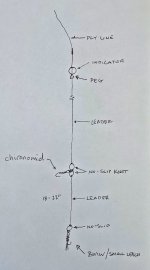
Since, I was talking about this on Saturday at the gathering and then answering a DM about the same... here is the picture of my set up. A "no-slip" knot to top fly and another "no-slip" at top of bottom leader.

20260601_090401~2.jpg
I need to see a picture 😁
How about a drawing...

The upper and lower fly change and switch places as the day goes along and bugs change.

Just my $0.02 worth and what do I know haha
 
Thanks Shawn! it is always interesting to see how different folk solve the same problems.

The combinations of being a big-time fly switcher (12 to 20 fly changes in a day are not uncommon), older fingers and eyes (takes more time and leader to tie knots as I'm about to leave my 70s) and more smaller patterns required to stay on top of the fish forced to me to modify my rigging methods to be more efficient (less rigging time and more fishing time). Thus, the approach I suggest at the start of this thread which to date seems to work the best for me.

Another change I have made in my leader construction is a switch to a straight piece of 20# fluorocarbon between the end of the fly line and the swivel, I have leader packets with various length of that 20# material (for example 5 feet, 10 feet, 15, feet and 20 feet lengths) rigged with a loop and bobber stop so I can change the loop to loop connection at the end of the fly line and the start of the leader as the fishing situation dictates. Having the solid piece of 20# material makes that change as well as untangling the frequent leader tangles I create much easier to deal with than lighter material. About the only change I see in my presentation than a more traditional leader is that the heavier fluorocarbon may sink faster than a lighter leader.

Curt
 
Thanks for the post Shawn. Petty much what I do most of the time. One question though. Why do you have the peg down on your indicator. I have gone back and forth on this for years.

Although after last trip out I am about totally done with slip strike indicators. I hate them. Just might stick with Oros and yes then landing a fish is tougher.
 
Since, I was talking about this on Saturday at the gathering and then answering a DM about the same... here is the picture of my set up. A "no-slip" knot to top fly and another "no-slip" at top of bottom leader.

View attachment 185353

How about a drawing...

The upper and lower fly change and switch places as the day goes along and bugs change.

Just my $0.02 worth and what do I know haha
Pretty much identical to what I do, but I don’t like chironomids as my top pattern. Personal preference. That and that whole peg down thing sheesh! 😂
 
Thanks for the post Shawn. Petty much what I do most of the time. One question though. Why do you have the peg down on your indicator. I have gone back and forth on this for years.

Although after last trip out I am about totally done with slip strike indicators. I hate them. Just might stick with Oros and yes then landing a fish is tougher.
So, my thinking is that by pegging from the bottom is that equal and opposite action cause the peg to release quicker and more often. When I set jerk the fly line/indicator up and the fish is pulling the peg/fly down i am doubling the force that separates the indicator from the peg.

Now a question for you, Why are you about totally done with quick release indicators? and What kind are you using?
 
So, my thinking is that by pegging from the bottom is that equal and opposite action cause the peg to release quicker and more often. When I set jerk the fly line/indicator up and the fish is pulling the peg/fly down i am doubling the force that separates the indicator from the peg.

Now a question for you, Why are you about totally done with quick release indicators? and What kind are you using?
Three reasons.
1. I find it hard to get the right amount of tension on between the peg and the indicator body. Keep coming loose just during casting or tight enough to not do that then it doesn't come loose when fighting a fish.
2. And the bodies wear down too fast which leads to the problem above.
3. Get tangles especially when using multiple flies way more than I do with Oros or Air Locks.

Couldn't tell you what brand I have been using lately. I am a indicator junkie and have tons of them.....lol. And I haven't noticed any being better or worse.
 
my .02 is that if you tie a tippet to the bend of a hook the fish will feel the tippet and not take.
The other point is with a barbless hook the tippet will slip off.
Most times I fish a two fly system is with a large dry fly and a small nymph
 
OK, get the guns out: slip indicator = plumbobber (now hard to find...!..), set placement with bobber stop; Seaguar floro to swivel; two tippets below swivel for two flies. Use Davy knots to swivel, Rapala knot to flies. Can even pre tie swivels for quick changes from blood worm to 'mid to balanced leech, to blob etc.
Only thing to remember is to check knots at least hourly and re tie as needed.
 
  • Like
Reactions: Zak
Three reasons.
1. I find it hard to get the right amount of tension on between the peg and the indicator body. Keep coming loose just during casting or tight enough to not do that then it doesn't come loose when fighting a fish.
2. And the bodies wear down too fast which leads to the problem above.
3. Get tangles especially when using multiple flies way more than I do with Oros or Air Locks.

Couldn't tell you what brand I have been using lately. I am a indicator junkie and have tons of them.....lol. And I haven't noticed any being better or worse.
Although not indicator junkie , I too switched to the oros last year ,no more slip indicators for me ,surprisingly the fish were still easy to land . Although most of my indicator fishing the water is usually never any deeper than 15'
 
Probably half of the stillwater fishing I do is 15-30’ deep. Slip indicators are an important piece of equipment! I typically keep a shallow indicator setup in the boat with a 12’ leader, just in case, but use a slip indicator there as well.
 
Although not indicator junkie , I too switched to the oros last year ,no more slip indicators for me ,surprisingly the fish were still easy to land . Although most of my indicator fishing the water is usually never any deeper than 15'
For what it is worth, I do like the Oros for some situations.

A few things I do to help my OROS game.
1. I use two different colors mixed together to help with contrast to see subtle takes.

2. I use two different sizes of OROS for the same reason.

3. I played around with an OROS for deep water applications after talking to the owner of the company about it. One solution is to use a tapered leader and not screw the indicator down super hard when placing it on the thicker part of the leader. When you have a fish on, you can reel the indicator up to your tip and with a little effort and pull, you can get the indicator to slip down the line that way. You need to use a little caution though, because they could unscrew all the way.
 
For what it is worth, I do like the Oros for some situations.

A few things I do to help my OROS game.
1. I use two different colors mixed together to help with contrast to see subtle takes.

2. I use two different sizes of OROS for the same reason.

3. I played around with an OROS for deep water applications after talking to the owner of the company about it. One solution is to use a tapered leader and not screw the indicator down super hard when placing it on the thicker part of the leader. When you have a fish on, you can reel the indicator up to your tip and with a little effort and pull, you can get the indicator to slip down the line that way. You need to use a little caution though, because they could unscrew all the way.
Some thread drift: Two years ago I was anchored up on a Kamloops area lake "2-pole" fishing one chironomid per long leader with contrasting coloured SeegerCator™'s. I was marking fish, quite a few fish at the depth my flies were hanging at. Something told me to shorten my casts so basically I just fished the same rigging right off the end of my fly rods. I had been missing subtle takes, super subtle - I wasn't able to see the slight "twitch" 25 to 40 feet away. With that change, the catching improved dramatically. Later, one of the locals, a superb chironomid fisher, suggested my presentations were a size too large and if I'd switched to smaller patterns that may have been the ticket for harder takes..... that I don't know about.


@Irafly - do I understand you correctly (item 2) that you're screwing two different diameter Oros indicators together?
 
Back
Top