speyflyfisher
Steelhead
Every so often an obscure (at least to me) fly pattern emerges in discussions on the fly fishing bulletin boards. This year it’s been the Black Pennell. It started with Dave’s post and then by a few others. It’s somewhat surprising that I haven’t ventured into classic wet fly patterns for trout considering I like to tie full dress atlantic salmon flies to fish for steelhead. But since I’m now fishing bamboo I might as well put a classic wet fly on the end of the tippet.
The Black Pennell was originated and first published by 1885 book Fishing, authored by the English public servant, writer, and avid fly fisherman Henry Cholmondeley-Pennell. Pennell devised the fly as a minimalist, universal attractor to imitate aquatic beetles, ants, and midge pupae. It’s a simple pattern with a tail of golden pheasant tippet, a black body (original would be floss), a silver rib and a hackle of black hen hackle. I tied mine with a dubbed body as a variant.
Tying a Black Pennell with Davie McPhail
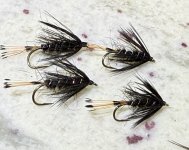
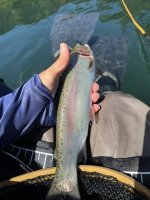
As we are about to transition from spring to summer, I choose a hike in lake above the foot hills but not quite high enough to be considered “alpine or high lake” in WA. I headed out early, at least early for a recently retired person, drove to the trail head and donned my pack and was off. 3ish miles and about 1000 feet gain later I arrived at my target destination. With the aid of my new micro rechargeable pump my float tube was inflated while I wadered up and prepare my Monsos bamboo stick terminated with a Black Pennell. It wasn’t long before the first tug but with a quick surge towards me the fish was off. Not long after it was fish on again with a nice rainbow to the hand. With a few more fish on the Black Pennell which proved its effectiveness. But as one who frequently leaves fish to look for fish or removes a hot fly to see what else will work, the Pennell was retired.
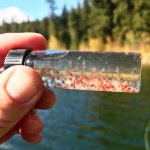
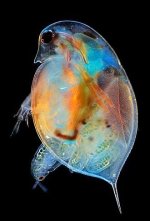
Immediately upon entering the water it was obvious that this lake has a healthy population of copepods. My fly change was to a Hardy’s favorite (originated in 1870) with a tippet tail, peacock herl body ribbed with red floss and partridge hackle and a wing of hen pheasant. I though the color of the floss I used matched the color of the copepods nicely. More fish fell pray to the Hardy’s favorite as well as an Olive Willy with its red glass bead head. After paddling around in the 50 degree water for a few hours I was getting cold and decided to pack it up and head out. Note to self: remember to bring rain pants even though the forecast was for sunny and 70’s. The brush that lines more west (wet) side trails have a lot of dew in the morning and having damp pant’s in your leaky waders doesn’t help one say warm.
Tying the Hardy's Favourite (Wet Fly) with Davie McPhail
The Black Pennell was originated and first published by 1885 book Fishing, authored by the English public servant, writer, and avid fly fisherman Henry Cholmondeley-Pennell. Pennell devised the fly as a minimalist, universal attractor to imitate aquatic beetles, ants, and midge pupae. It’s a simple pattern with a tail of golden pheasant tippet, a black body (original would be floss), a silver rib and a hackle of black hen hackle. I tied mine with a dubbed body as a variant.
Tying a Black Pennell with Davie McPhail
As we are about to transition from spring to summer, I choose a hike in lake above the foot hills but not quite high enough to be considered “alpine or high lake” in WA. I headed out early, at least early for a recently retired person, drove to the trail head and donned my pack and was off. 3ish miles and about 1000 feet gain later I arrived at my target destination. With the aid of my new micro rechargeable pump my float tube was inflated while I wadered up and prepare my Monsos bamboo stick terminated with a Black Pennell. It wasn’t long before the first tug but with a quick surge towards me the fish was off. Not long after it was fish on again with a nice rainbow to the hand. With a few more fish on the Black Pennell which proved its effectiveness. But as one who frequently leaves fish to look for fish or removes a hot fly to see what else will work, the Pennell was retired.
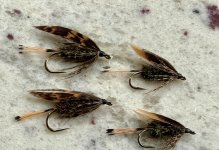
Immediately upon entering the water it was obvious that this lake has a healthy population of copepods. My fly change was to a Hardy’s favorite (originated in 1870) with a tippet tail, peacock herl body ribbed with red floss and partridge hackle and a wing of hen pheasant. I though the color of the floss I used matched the color of the copepods nicely. More fish fell pray to the Hardy’s favorite as well as an Olive Willy with its red glass bead head. After paddling around in the 50 degree water for a few hours I was getting cold and decided to pack it up and head out. Note to self: remember to bring rain pants even though the forecast was for sunny and 70’s. The brush that lines more west (wet) side trails have a lot of dew in the morning and having damp pant’s in your leaky waders doesn’t help one say warm.
Tying the Hardy's Favourite (Wet Fly) with Davie McPhail
Last edited: