Larger businesses are able to fend off high taxes more effectively and employ people in numbers (often at just above poverty rate). This can drive out small business in competitive terms and in the cut the government requires. I'm sure our state is friendlier to big business than small. Even in my hometown the local Wal Mart was heralded as a job thing and got tax negative status. The result was shuttering of small shops that had been there for generations in many cases and the social assistance systems picking up where Wal Mart left off. In other words the citizens made up for poverty wages. Much of the data in Washington I'm sure is skewed my big tech in king county etc. I don't concur this gas tax will help anyone avoid poverty. I don't think taxes cause prosperity. Just food for thought.
I don't know if higher taxes lead to lower poverty rates. It certainly goes against conventional wisdom.
I can think of scenarios where they could help. I have researched for data supporting these thoughts, but here goes:
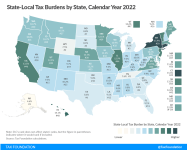
If one were to show which states/ areas spend more on education, I think that you would see that it would mostly correlate with lower poverty rates. Education spending drives my state and local tax bill (property tax). We are pretty heavily taxed in B'ham. We have new schools all over. The town is growing rapidly. There are other reasons for the growth too, so it's hard to say for certain.
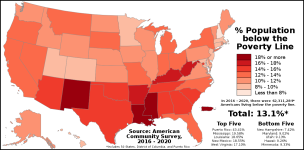
My curiosity is if the wealthier areas are more likely to tax themselves or if the areas that have better schools/ infrastructure due to higher taxes are better able to attract the people and therefore the businesses that allow for greater prosperity. It's a which comes first, the chicken or the egg scenario. It is probably a factor of many things, not just taxes. Alternatively, the reason that the South/ lower Mississippi valley has high poverty rates has nothing to do with taxation. The reason that NJ and Mass and Minn have low poverty rates have nothing to do with taxation. It's a correlation without any causation.
I have also considered that taxation rates may be an proxy for another factor that is the main driver such as a cultural trait endemic to a region or education. I am curious where this Five-Thirty-Eight series goes:
ABC News is your trusted source on political news stories and videos. Get the latest coverage and analysis on everything from the Trump presidency, Senate, House and Supreme Court.

fivethirtyeight.com
Since voting has a direct correlation to taxation, who a region votes for will show their collective stance on taxes (and other things). If we then take that majority voter base and see what they believe in with regards to education or social safety nets, or Wal-Marts etc., then we may see a correlation at least. This could also explain why certain high tax areas don't have the poverty rates that would be expected, knowing that certain taxes hit low income earners more.
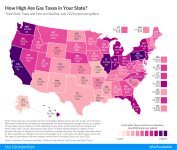
If this gas tax does lead to more electric cars on the road and electric cars are in fact how the country goes, it may be wise in the long run to have a population that has already transitioned. You would get the trend setter electric mechanics, dealerships, infrastructure etc. I am not sure that it would make up for $0.49 / gal. during the transition but maybe it's a good thing economically to be seen as leading the way. Maybe the population that is willing to change, and therefore willing to vote for a gas tax hiker, is the one better able to change. The only constant is change. This may get back to demographic trends predicting poverty rates/ affluence and not taxation.
These are my rambling thoughts. I am not nearly as funny as Chromers. I apologize for that.








 the thread will be closed when it runs its course and another will come along eventually, like the sun rising in the east.