
Navigation
Install the app
How to install the app on iOS
Follow along with the video below to see how to install our site as a web app on your home screen.
Note: This feature may not be available in some browsers.
More options
Style variation
You are using an out of date browser. It may not display this or other websites correctly.
You should upgrade or use an alternative browser.
You should upgrade or use an alternative browser.
Affordable places you would actually want to live
- Thread starter jaredoconnor
- Start date


jaredoconnor
Peabrain Chub
I appreciate all the well meaning career advice, but that was never the purpose of this thread. I have skills that I can deploy, if I need to continue doing something. Reducing our expenses reduces how long I will need to do that though, which is why I was curious to hear everyone’s thoughts about living in different places.
For anyone following at home and trying to make sense of all this for themselves, I have a confronting comment to make; I believe it is too late to pivot into something that you’re not already proficient at, for a few reasons.
1. Professions that seem safe now will become oversaturated. Supply and demand will dictate dramatically lower compensation. Considering the time it takes to become proficient at something, I believe many will be unable to meet their financial goals via these jobs.
2. Other professions carry the risk of obsolescence, at which point any investment into that profession would be a loss and could leave you in a worse position than if you had done nothing.
3. New jobs will be created. I believe this is what most should focus on. However, we won’t know what those new jobs are until the dust settles.
When all this happens is up for debate. It may not happen for a long time and make this entire thread irrelevant. However, it could also come sooner and we’ll have to deal with all this. Time will tell.
For anyone following at home and trying to make sense of all this for themselves, I have a confronting comment to make; I believe it is too late to pivot into something that you’re not already proficient at, for a few reasons.
1. Professions that seem safe now will become oversaturated. Supply and demand will dictate dramatically lower compensation. Considering the time it takes to become proficient at something, I believe many will be unable to meet their financial goals via these jobs.
2. Other professions carry the risk of obsolescence, at which point any investment into that profession would be a loss and could leave you in a worse position than if you had done nothing.
3. New jobs will be created. I believe this is what most should focus on. However, we won’t know what those new jobs are until the dust settles.
When all this happens is up for debate. It may not happen for a long time and make this entire thread irrelevant. However, it could also come sooner and we’ll have to deal with all this. Time will tell.
Last edited:

Pink Nighty
Legend
The only thing keeping those jobs from being replaced is economic feasibility. Once the robots and tech are cheaper than the mechanic, bye bye mechanic. Shit, most mechanics can't even tell you what's wrong with your car anymore without the reading the computer code.Evan,
Please show me an AI or robotic factory that repair a damaged or defective car, milk a cow, correctly install wiring or plumbing, fix said systems and contribute to the tax base.
No matter what tech can do, skilled humans will always be needed to control and repair things.
Yes there are machines that can lay bricks and blocks and concrete for buildings. Yes, Lego is almost totally automated.
There's always going to be a need for a skilled human in the loop. Our problem is figuring out where to abandon old crafts amd skills and develop new ones to compensate.
Those of us in trades and services are gonna make it a little longer than those whose jobs essentially organize and analyze data, which is one hell of a lot of white collar jobs.
Your absolutely right that people are underestimating the number of people who are about to be displaced by AI.
But these events have happened before and mankind not only survived, but prospered as a result. So AI will be a great thing, after the dust settles, BUT all economic, social and geo-political transitions are uncomfortable for the folks undergoing the transition.
I saw the handwriting on the wall in the mid-1980's that the Forest Service was going to get much, much smaller as an agency. I started looking for a community and a National Forest that I thought could weather the storm. I didn't realize that it would go on for twenty years!! BUT I got to move to Wenatchee with a Forest Service job and for a variety of reasons Wenatchee and the local National Forest were best suited to ride out the environmental wars. I didn't lose my job, nor did I have to move to keep it.
I think people depending on their circumstances need to consider that the next decade will be a tumultuous decade and plan accordingly. Your choice of community to move to will depend on your specific circumstances: you should at least think hard about it.
I have just started using AI for help in writing papers on current forestry issues. It is not ready for prime time, yet. But I have a colleague whose sons work as civil engineers. Their comment is that AI has reduced their workload on projects from 30 days to ONE. That is an incredible gain in productivity!!!
If I had it when I was doing policy analysis, AI would have increased my productivity by a factor of 10 or more. In the olden days, I had to be computer literate to run all the economic models, and had people working for me that could run ArcInfo GIS to do the required analysis. All of that will change in the near future.
We are not quite there with AI today, but it is just a programming issue that will resolve itself quickly over time.
I have watched a several interviews with Bessent the Treasury Secretary, and Rollins the Agriculture Secretary.
In the interviews, the reporters asked them about immigration and the need for unskilled labor.
Both of them gave the same answer. We are NOT going to need unskilled labor in the near future. The reporters never followed up on the question, but US policy is all in on AI. The thinking is the country that wins the AI race, will control the 21st century.
Knowing HOW to do things is going to be much less important in the near future. Knowing WHY your doing things will become critical.
AI, geo-politics, the debt crises, and change in generational values are all coming to a head at the same time.
It will be interesting to say the least. I am glad that I am young enough to see it happen, but old enough that it won't matter to me on the outcome.
The good news is that most of the communities that fly fisherpeople are looking to move to are these days with StarLink, Amazon, ebooks and a host of other services much nicer than they were 40 years ago from a lifestyle point of view. Fishing has gone downhill however!!!
Chose your community carefully. Wenatchee worked for me for almost 35 years. I can handle the rapid decline in the last decade forward.
Oh, the plebes will not be left holding the bag. There are too many of them in this case.
BUT just in case, be sure that you vote for intelligent people that will understand WHY we will need to make a societal transition, and know HOW to manage it.
Otherwise, it might get real bad during the transition.
But these events have happened before and mankind not only survived, but prospered as a result. So AI will be a great thing, after the dust settles, BUT all economic, social and geo-political transitions are uncomfortable for the folks undergoing the transition.
I saw the handwriting on the wall in the mid-1980's that the Forest Service was going to get much, much smaller as an agency. I started looking for a community and a National Forest that I thought could weather the storm. I didn't realize that it would go on for twenty years!! BUT I got to move to Wenatchee with a Forest Service job and for a variety of reasons Wenatchee and the local National Forest were best suited to ride out the environmental wars. I didn't lose my job, nor did I have to move to keep it.
I think people depending on their circumstances need to consider that the next decade will be a tumultuous decade and plan accordingly. Your choice of community to move to will depend on your specific circumstances: you should at least think hard about it.
I have just started using AI for help in writing papers on current forestry issues. It is not ready for prime time, yet. But I have a colleague whose sons work as civil engineers. Their comment is that AI has reduced their workload on projects from 30 days to ONE. That is an incredible gain in productivity!!!
If I had it when I was doing policy analysis, AI would have increased my productivity by a factor of 10 or more. In the olden days, I had to be computer literate to run all the economic models, and had people working for me that could run ArcInfo GIS to do the required analysis. All of that will change in the near future.
We are not quite there with AI today, but it is just a programming issue that will resolve itself quickly over time.
I have watched a several interviews with Bessent the Treasury Secretary, and Rollins the Agriculture Secretary.
In the interviews, the reporters asked them about immigration and the need for unskilled labor.
Both of them gave the same answer. We are NOT going to need unskilled labor in the near future. The reporters never followed up on the question, but US policy is all in on AI. The thinking is the country that wins the AI race, will control the 21st century.
Knowing HOW to do things is going to be much less important in the near future. Knowing WHY your doing things will become critical.
AI, geo-politics, the debt crises, and change in generational values are all coming to a head at the same time.
It will be interesting to say the least. I am glad that I am young enough to see it happen, but old enough that it won't matter to me on the outcome.
The good news is that most of the communities that fly fisherpeople are looking to move to are these days with StarLink, Amazon, ebooks and a host of other services much nicer than they were 40 years ago from a lifestyle point of view. Fishing has gone downhill however!!!
Chose your community carefully. Wenatchee worked for me for almost 35 years. I can handle the rapid decline in the last decade forward.
Oh, the plebes will not be left holding the bag. There are too many of them in this case.
BUT just in case, be sure that you vote for intelligent people that will understand WHY we will need to make a societal transition, and know HOW to manage it.
Otherwise, it might get real bad during the transition.
jaredoconnor
Peabrain Chub
The only thing keeping those jobs from being replaced is economic feasibility. Once the robots and tech are cheaper than the mechanic, bye bye mechanic. Shit, most mechanics can't even tell you what's wrong with your car anymore without the reading the computer code.
Those of us in trades and services are gonna make it a little longer than those whose jobs essentially organize and analyze data, which is one hell of a lot of white collar jobs.
I’ve mentioned it a few times, but I don’t believe the risk to trades is robots. I believe the risk to trades is over supply, resulting in low pay. All the indicators are already there, such as gatekeeping of apprenticeships.
Ironically, this reduces the likelihood of robots being used for any given task. Robots usually replace expensive or unreliable humans.

Scudley Do Right
Legend
I know this was a question on where to live but a few people are suggesting you learn a trade. I don't know how many them work in a trade. It's not for everyone and changing from a desk job to manual labor is going to be a shock to the system. You can make more than most people think you do. The pay scales of union jobs are public knowledge. Call whatever one interests you and ask what the journey rate is. The otherside people aren't mentioning is you pay with your body. I just turned 41 and all I want to do is ride my bike with my kid but my body doesn't want to let me. It depends on the trade and genetics but the majority of people I work with over mid 30's hurts somewhere. There isn't a day I don't hurt somewhere. I don't know if the OP is even considering a trade but I thought I would offer a different point of view.

Healthcare will always provide jobs, especially in an aging America, the current shortage in nurses is hundreds of thousands and will only grow as nurses age out. This shortage was also acute in the 80's which led to the US 'importing' tens of thousands of nurses from the Philippines, which for obvious reason is no longer an open pipeline.
My son at Google is part of a multi tech company 'futurist' consortium of smart folks who discuss the future of everything using input on what they know is either active or in development, and their discussions do not point to just more changes we will adapt to that will become the new norm and for good reason.
Until now, every significant advance in technology created new jobs that balanced out the gradual elimination of 'old skills. This is different, as the nexus of AI, robotics, and 3D printing will create far fewer jobs than they will displace.
So a good time for those still in mid work life or just starting out to think carefully about their options.
My son at Google is part of a multi tech company 'futurist' consortium of smart folks who discuss the future of everything using input on what they know is either active or in development, and their discussions do not point to just more changes we will adapt to that will become the new norm and for good reason.
Until now, every significant advance in technology created new jobs that balanced out the gradual elimination of 'old skills. This is different, as the nexus of AI, robotics, and 3D printing will create far fewer jobs than they will displace.
So a good time for those still in mid work life or just starting out to think carefully about their options.

I think this is the part most aren't realizing. This is 110% different. Sure, we've always dealt with advancing technology, but not like this. Not this suddenly either. Again, I don't think the vast majority of people (myself included) fully grasp what this technology is or can be.This is different, as the nexus of AI, robotics, and 3D printing will create far fewer jobs than they will displace.
I don't at all believe advanced robotics with AI learning will replace all manual labor jobs usually done by people; but in time, it'll replace enough that it's going to hurt, adding to that dilution of the job candidate pool that @jaredoconnor brought up.
None of us truly know how this is going to turn out, but forecasts aren't particularly sunny for most of us.

AI, like computers, will be able to be hacked, and used by bad actors at a level nobody can really predict, but it'll happen.
Society passively accepts all these technological advancements due to their incremental nature. While each individual advancement appears positive or harmless on its own, they are obscuring the massive, negative cumulative effect on society and human freedom.
Society passively accepts all these technological advancements due to their incremental nature. While each individual advancement appears positive or harmless on its own, they are obscuring the massive, negative cumulative effect on society and human freedom.
I consider myself quite tech savvy and do everything I can to keep up on staying that way.
But if I could dial back our computer technology to like... 2006, I would. Right before algorithmic social media and news feeds, before AI, and a long list of other things. Back when the internet was fun and not a giant revenue-generating behemoth for major tech companies.
For example: This very forum style you're on here is a relic from that era that stood the test of time. But it also struggles to hold the attention of anyone much younger then mid 30s or so since they were too young to appreciate that era of awesome internet.
But if I could dial back our computer technology to like... 2006, I would. Right before algorithmic social media and news feeds, before AI, and a long list of other things. Back when the internet was fun and not a giant revenue-generating behemoth for major tech companies.
For example: This very forum style you're on here is a relic from that era that stood the test of time. But it also struggles to hold the attention of anyone much younger then mid 30s or so since they were too young to appreciate that era of awesome internet.
Last edited:

Reporter Beth Macy (wrote Dopesick) just finished a book called Paper Girl about the changes in Urbana, OH, from when she grew up there till now. She was finding the people who helped encourage and mentor her back when she was a girl, the kind of community that cared and advised and encouraged her, by and large has changed into a hyper-polarized mess. For a curious kid who might grow up there now, that small town environment of yore is now limited by practicalities, conformity and loss of resultant curiosity. She saw it as opportunities are slimmer, blunter. So yes, clearly she has a perspective that is lopsided, on the other hand, she is an astute observer, irrespective of Paper Girl, Dopesick was phenomenal. (If you haven't seen the Michael Keaton tv series under same name, whoah- super powerful stuff)It’s also as rewarding as work can possibly be IMHO. I teach 7th and 8th grade math. It is not glorious, but every single day I get the chance to mentor students that have no one else looking out for their academic success/acquisition of basic math skill.
Teachers encouraged her, multiple times along the way, to dream big and go places, she went from delivering papers in Urbana to becoming a well regarded reporter and author. JS nails it in his quote above, who looks out for the success of others? For Macy, probably all of us, teachers were so influential. Many of those teachers were not in the classroom, were not even restricted to school age, but possessed an eye for possibility and a path for betterment. If we are talking about trades to learn, Teacher remains even when the AI overlords and robot armies come...(and if it doesn't we are screwed ). Within that role, that of teacher, is a deep sense of meaning and self worth.
The flip side, not self worth, but actual worth, teaching doesn't pay nearly what it should, it's not valued so much as assumed that someone will do it. The point Beth Macy makes is that you can no longer assume an environment that promotes creativity and possibility.
Or take it a step further, you can no longer assume there are teachers who see possibilities for their students.
These discussions are always interesting to me. Where is better than here? Flannery O'Connor summed a grass-is-greener philosophy for one of their characters
"Where you come from is gone, where you thought you were going to never was there, and where you are is no good unless you can get away from it"
For me and for a while, or a life stage, many places were wonderful, or was it wonderful in retrospect as I remembered the good parts about it? And for many of those place they became less wonderful- Boston had chiggers, MIL and ticks. As I got older they were places I definitely wanted to leave...
The place I want to retire to I currently conceive of as a place where I can do the things I love to do in my 50's, but is it the same as what I am going to love to do (or can do) in my 70's? My whole life (probably my wife's too) the interests I- or she- has, tends to shift every 15 years or so. Not complete 180s or anything, just new layers and sediments. In my 80's, if I make it that far, what matter is place in the face of senescence? Is it a place without threat? Is it a place of deep loneliness (terrifying) or calm solitude and peace (wonderful)? Seems like you could have those outcomes anywhere there's geography. So part of it, particularly where you end up, remains a mental state.
Back to Beth Macy though, As a glass half empty thought exercise, is the place you move to going to be a place where curiosity goes to die?
Dimebrite mentions Dubai, interesting to me as a centralized airport to stage from, not to live. It's a place without weird driftwood. In my mental hierarchy of places to live- forest, river, mountain and sea figure highly. That's what you need for cool driftwood. Chigger-less Dubai doesn't check those boxes. Driftwood as metaphor- shaped, weathered, partially rotten, preserved best where saps and growths hardened under great burdens, busted from the hill under rain and river flood, floated, tumbled, smashed. An origin story, yet a possibility too, how to sculpt a new chapter out of it.
Wandering Richard's notion here is super interesting to me- a place with a complex story (throw in Geologic) to figure or speculate about (so throw in Eastern Pennsylvania too). Reading can only get your curiosity so far, seeing it, touching it, imagining a formation on a hill, a canon's sight line, the arrowhead in the creekbed, the boot print on the trail, how did a difference in philosophy become the letting of blood, death...
( anyone else watching Ken Burns Revolutionary War doc? On my list next...)Take a hard look at central and western Pennsylvania. .....
Historical sites are everywhere. Pre colonial? check. French and Indian War? check. Revolutionary ? yep. Whiskey Rebellion, Molly McGuires, have those too.
Last edited:

Yeah, if anyone has been following, Ford is losing mechs and techs by the 1000's, Farley is whining he can't find 40,000 workers for just his dealership jobs and the automotive post sale service industry is even worse.The only thing keeping those jobs from being replaced is economic feasibility. Once the robots and tech are cheaper than the mechanic, bye bye mechanic. Shit, most mechanics can't even tell you what's wrong with your car anymore without the reading the computer code.
Those of us in trades and services are gonna make it a little longer than those whose jobs essentially organize and analyze data, which is one hell of a lot of white collar jobs.
Biggest issue is the fact cars are toooo F'n computerized with poor QC and poor networking, the "engineering" is based on throw away instead of repair, and the pay and training is crap. No wonder people are avoiding that career path, and consumers are holding on to thier older cars.
I wanna see AI physically unclog the sewers when they back up. Or respond to a semi that's rolled over and set it back on its wheels inside 1 1/2 lanes of traffic like the guys at Pepe's Towing in LA
Last edited:

The Trade industry has changed and continues to change quietly behind the scenes. When we were growing up there were lots of local (Mom 'n Pop) small businesses which were making a decent living while providing quality service and customer care. This is what helped make our middle-class. Many of those business owners are nearing retirement and quitting/selling their businesses.
Large corporate, private equity investment groups with deep pockets are buying these up quickly. For example, in Washington, many of the plumbing, electrical, veterinarian, nursing homes, and HVAC small companies have been bought up. Same company name, charging more and providing, in many cases, less quality service. Less competition so getting bids for the best price from multiple businesses is reduced or no longer existent. The 'local' call center is in Florida or Texas. These private equity investment groups are buying up phone numbers for businesses to obtain previous clientele. Go to "About Us" page on websites and see if you can find the name of the owner.
Private investment groups are doing this to make money - lots of it. This will affect job stability, pay, and service. So, if you are looking at the Trades, research more, to know what you are getting into.
I fully support our local small businesses whether it be a plumber or fly shop. I research them out carefully too. If we do not, they will go by the wayside...
Large corporate, private equity investment groups with deep pockets are buying these up quickly. For example, in Washington, many of the plumbing, electrical, veterinarian, nursing homes, and HVAC small companies have been bought up. Same company name, charging more and providing, in many cases, less quality service. Less competition so getting bids for the best price from multiple businesses is reduced or no longer existent. The 'local' call center is in Florida or Texas. These private equity investment groups are buying up phone numbers for businesses to obtain previous clientele. Go to "About Us" page on websites and see if you can find the name of the owner.
Private investment groups are doing this to make money - lots of it. This will affect job stability, pay, and service. So, if you are looking at the Trades, research more, to know what you are getting into.
I fully support our local small businesses whether it be a plumber or fly shop. I research them out carefully too. If we do not, they will go by the wayside...
I appreciate all the well meaning career advice, but that was never the purpose of this thread. I have skills that I can deploy, if I need to continue doing something. Reducing our expenses reduces how long I will need to do that though, which is why I was curious to hear everyone’s thoughts about living in different places.
For anyone following at home and trying to make sense of all this for themselves, I have a confronting comment to make; I believe it is too late to pivot into something that you’re not already proficient at, for a few reasons.
1. Professions that seem safe now will become oversaturated. Supply and demand will dictate dramatically lower compensation. Considering the time it takes to become proficient at something, I believe many will be unable to meet their financial goals via these jobs.
2. Other professions carry the risk of obsolescence, at which point any investment into that profession would be a loss and could leave you in a worse position than if you had done nothing.
3. New jobs will be created. I believe this is what most should focus on. However, we won’t know what those new jobs are until the dust settles.
When all this happens is up for debate. It may not happen for a long time and make this entire thread irrelevant. However, it could also come sooner and we’ll have to deal with all this. Time will tell.
Well said. I agree with a lot you just posted. I truly believe it is already happening and a lot quicker than many of us imagined. It will be far more reaching too. My concern is 'when the dust settles' it will be too late. No chicken Little and the sky is falling.
Last edited:

Fourbtgait
Life of the Party
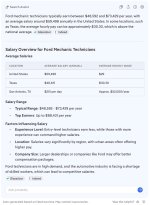
Speaking of Ford, below is AI salaries for mechanics. Note the yearly salary amount. At an average of $73,000 a year, that salary can afford a $219,000 house. Hopefully their partner makes as much money as well in order to afford what is an average house price, $363,000 though it’s a bit higher in my area. Blue collar jobs are never going to pay as well as white collar jobs and as another stated before, as a blue collar worker, your body takes a lot of abuse. If I knew then how I was going to be now, I would have finished college.Yeah, if anyone has been following, Ford is losing mechs and techs by the 1000's, Farley is whining he can't find 40,000 workers for just his dealership jobs and the automotive post sale service industry is even worse.
Biggest issue is the fact cars are toooo F'n computerized with poor QC and poor networking, the "engineering" is based on throw away instead of repair, and the pay and training is crap. No wonder people are avoiding that career path, and consumers are holding on to thier older cars.
I wanna see AI physically unclog the sewers when they back up. Or respond to a semi that's rolled over and set it back on its wheels inside 1 1/2 lanes of traffic like the guys at Pepe's Towing in LA
Where we live was as great choice. We have been here 25+ years. On a great fishing small lake, 15 minutes to moving water and a great Level II trauma center, ~30 minutes to the airport and salt water for fishing for SRC and coho, 10 minutes to hiking in the Issaquah Alps and lots of shopping within 15 minutes, including Costco. Traffic - have to drive to it to find it. We live in a county and not within any city limits. We are in an end of the road community so traffic is minimal and very quiet. Lots of wildlife around and only garter snakes. Most of my neighbors are on acreage and we only have peekaboo views of houses around us. The public schools here are great too.
We are on fixed income and property taxes are hurting us big time. For example, our property taxes went up 29% in 2017, 13% in 2018, 12%+ in 2022 and 2024 and another 12.9% for next year. It is great to see our home value go up, but be careful what you wish for too...
Washington State law limits the annual growth of the total regular property tax levy to 1%. In 2025, there was a push to increase this tax rate to 3%. Fortunately, it was defeated but only a matter of time...
We are on fixed income and property taxes are hurting us big time. For example, our property taxes went up 29% in 2017, 13% in 2018, 12%+ in 2022 and 2024 and another 12.9% for next year. It is great to see our home value go up, but be careful what you wish for too...
Washington State law limits the annual growth of the total regular property tax levy to 1%. In 2025, there was a push to increase this tax rate to 3%. Fortunately, it was defeated but only a matter of time...
Last edited:

Sort of off topic but have you checked into property tax exemptions for seniors (don't know your age but if you're on fixed income...) and low income? They don't really advertise it but check with your county. Ours was cut in half when we retired.We are on fixed income and property taxes are hurting us big time.

Evan,
Please show me an AI or robotic factory that ... milk a cow ....
Having milked cows during grad school, I can attest to "who wants to milk cows at 3:00 AM? I sure didn't (but did).
cheers
Sort of off topic but have you checked into property tax exemptions for seniors (don't know your age but if you're on fixed income...) and low income? They don't really advertise it but check with your county. Ours was cut in half when we retired.
Great point! Yes, I do check every year. Our county is not very friendly in that regard.
going forward, living within commute distance of a major employment hub which are usually the metro's, will become more important for those who aren't assured of job continuity in their line of work.I think this is the part most aren't realizing. This is 110% different. Sure, we've always dealt with advancing technology, but not like this. Not this suddenly either. Again, I don't think the vast majority of people (myself included) fully grasp what this technology is or can be.
I don't at all believe advanced robotics with AI learning will replace all manual labor jobs usually done by people; but in time, it'll replace enough that it's going to hurt, adding to that dilution of the job candidate pool that @jaredoconnor brought up.
None of us truly know how this is going to turn out, but forecasts aren't particularly sunny for most of us.
As to 'always need someone to unplug the sewer line, respond to a wreck, etc':
"Forecasts on job displacement in the U.S. due to AI, robotics, and 3D printing vary widely, with some reports projecting up to 100 million jobs at risk over the next decade."
Considering there are approx 160 million jobs in the US, that would be flat out ruinous, and likely not to happen simply because without paying jobs there are no customers to buy the goods and services, or tax dollars to run the government, so would expect legislation at both state and federal level to hold back the tide.
BTW, the quote? Straight from Google AI... the friggin irony